Configuration guide
Murphy Beds with Storage: Drawers, Shelves, and Side Cabinets
Side towers and drawers are how a wall bed earns its footprint the other 360 days.
Short answer
Murphy beds with storage add drawers, shelves, or full side cabinets to the bed unit — turning a wall bed into a small closet. There are three formats: base drawers (cabinet beds), integrated shelves (wall beds with a desk or sofa), and side storage towers flanking the bed. Which one you want depends on how much wall you have and what you need to store.
Three storage formats — pick by what you need to hold
Every Murphy bed with storage falls into one of three patterns. They serve different needs.
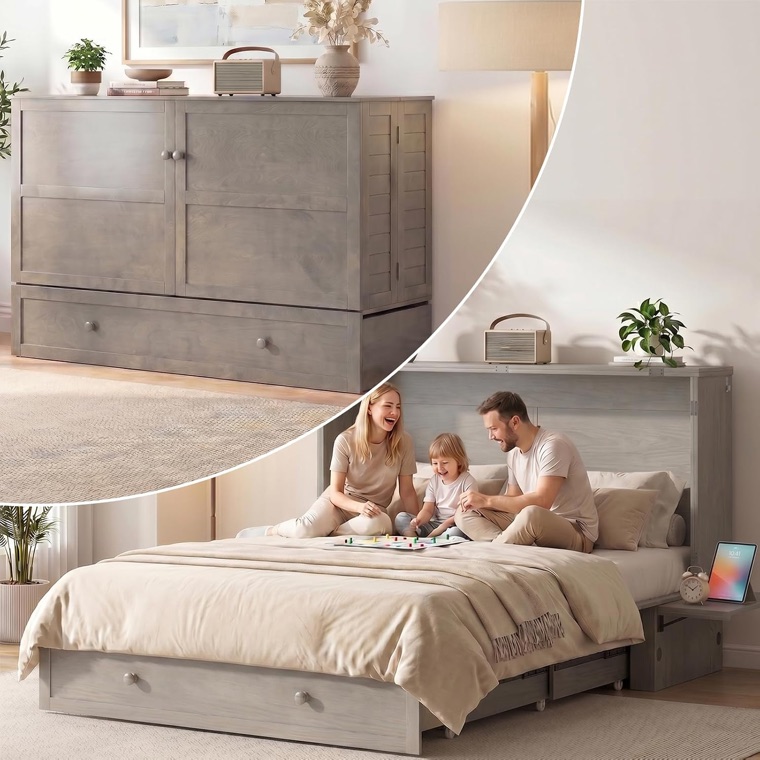
Base drawers (cabinet beds). Freestanding chest cabinet with one or two drawers built into the base. Storage is under the folded mattress. Best for: bedding, clothes for a guest room, the stuff that would live in a nightstand.
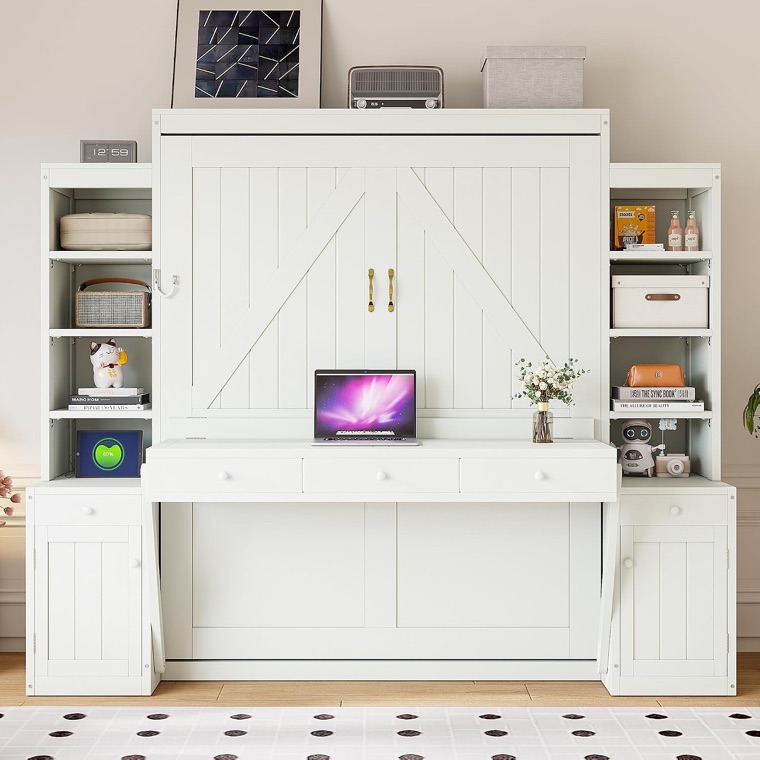
Integrated shelves and desk drawer (wall beds with a desk or sofa). The bed’s front panel is a workspace or seating, so the storage lives around it — front-panel shelves, a desk drawer, maybe an outlet cubby. Shallow but useful. Best for: books, decor, home-office supplies.
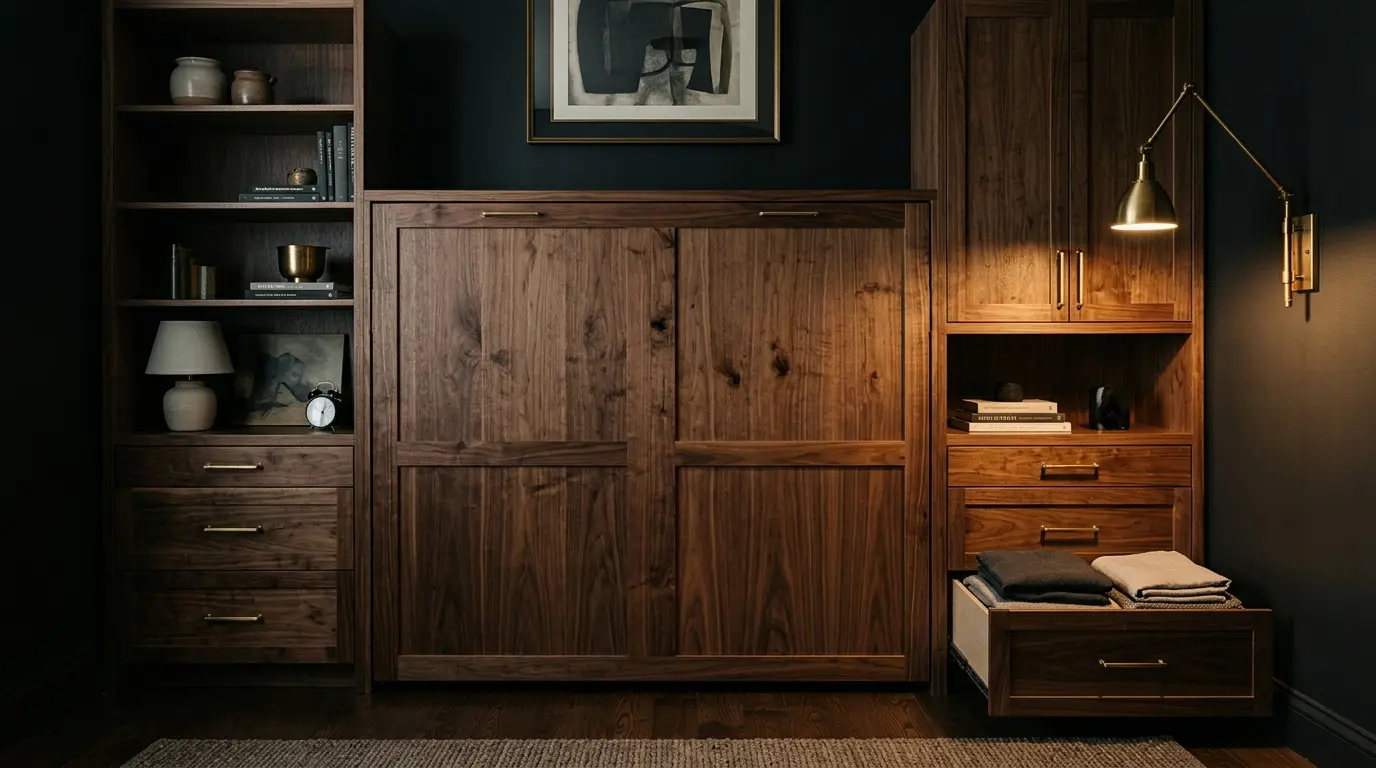
Side storage towers (wall bed + flanking cabinets). The bed is centered on the wall with a vertical storage cabinet on each side. Nearly closet-scale capacity. Best for: bedrooms with no closet, guest rooms that also store off-season items.
If you don’t need much storage and just want the bed, skip these and read the vertical Murphy bed guide instead.
Base drawers: cabinet bed storage
Cabinet beds put drawers in the base. Because the whole unit is chest-height, the drawers are usually 5 to 8 inches deep — good for folded sheets, spare pillows, spare bedding.
Two things to check:
- Drawer side. Drawers open on one specific end of the cabinet. If you shove the cabinet against the wrong wall, you can’t open them.
- Drawer count. Most queen cabinet beds have one or two drawers plus a shelf. That’s the ceiling — cabinet beds can’t have more drawers without changing the cabinet height.
For more on the format, see the Murphy cabinet bed guide.
Integrated front-panel storage: desk beds and sofa beds
The Murphy bed with a desk and the Murphy bed with a sofa both put their storage into the bed’s front panel. It looks like a lot of storage in the product photo, but it isn’t.
- Shelves are shallow. The panel can’t be deeper than the fold mechanism allows, which caps shelves at about 8 to 10 inches. Fine for books, tight for storage bins.
- Load rating matters. Anything heavy on the front panel changes the balance of the bed when it folds. Confirm the listing’s rated load.
- LED lighting is a common add. Not storage, but often bundled — worth knowing.
Side storage towers: closet-scale capacity
The biggest-capacity Murphy storage format is a wall unit with a vertical storage tower flanking each side of the bed. Format looks like a built-in — bed center, closet-style cabinets left and right.
- Wall width required is large — 90 to 105 inches for a full-size bed with matched towers.
- Each tower is usually 15 to 18 inches deep — enough for hangers on short rods, folded clothes, or bin storage.
- Anchoring is critical. The bed and both towers are anchored independently. Confirm the stud pattern for the whole assembly.
Storage format comparison
| Format | Storage capacity | Wall width | Best for |
|---|---|---|---|
| Base drawers (cabinet bed) | Small (nightstand-equivalent) | ~65“ (queen) | Guest room, no wall anchoring |
| Front-panel shelves + desk drawer | Small (books, decor) | ~65–75“ | Home office, den |
| Side storage towers | Large (small-closet-equivalent) | 90“+ | Bedroom without a closet |
What to measure before you buy
- Wall width for the whole unit including any side towers plus 3“ trim clearance each side.
- Total depth from wall — side towers can extend further than the bed cabinet.
- Ceiling height — full-height wall beds with towers usually need 88 inches or more.
- Stud pattern — every wall bed with side cabinets needs anchoring across a wider stud span.
- Delivery access — a wall unit with side cabinets ships as multiple large boxes. Measure your stairwell.
Common mistakes
- Buying front-panel shelves as “storage.” They’re display space, not storage. Anything you’d put in a bin doesn’t fit.
- Overloading side towers. These are furniture-grade, not built-in-grade. Follow the load rating.
- Ignoring drawer side on cabinet beds. Wrong side = drawer opens into corner.
- Underestimating wall width. A bed + two side cabinets is a 90“+ commitment. Measure twice.
Pre-purchase checklist
- Wall width for the full unit + 3“ trim each side
- Closed depth measured, including any side-cabinet depth
- Ceiling clears the tallest section with 2“ of headroom
- Stud pattern matches the assembly’s anchoring plan
- Drawer/tower sides match room layout
- Load rating confirmed for shelves and drawers you plan to fill
If your wall isn’t wide enough for side towers, a Murphy bed with a desk or a queen cabinet bed with base drawers is the honest smaller-footprint answer. For very tight rooms, see the small-room guide.