Configuration guide
Murphy Bed with a Desk: Wall Beds That Fold Down Over a Workspace
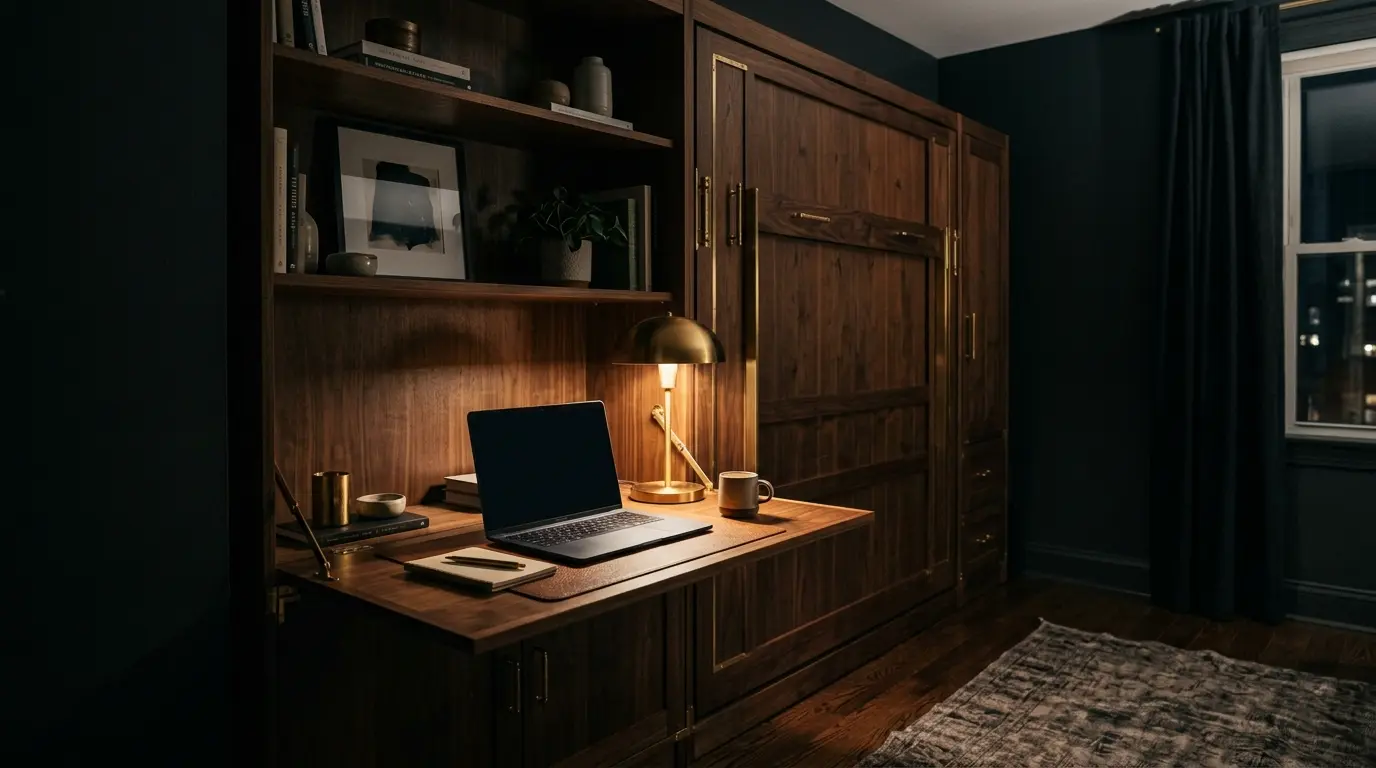
The desk stays up and stays loaded; the bed folds down over it when guests arrive.
Short answer
A Murphy bed with a desk is a vertical wall bed whose front panel is a desk. The desk stays clear of the mattress when the bed folds up, and swings out of the way when the bed folds down. It's the right pick for a one-room office that has to sleep a guest a few nights a month — not for anyone who needs the desk usable while someone is asleep.
Who a Murphy bed with a desk is actually for
A Murphy bed with a desk solves one specific problem: a room that has to be a home office almost every day and a bedroom a few nights a month. The desk stays up, the bed stays hidden, and the room doesn’t have to be reset every morning.
It’s the wrong pick if your desk and your bed both get real daily use. On almost every desk-integrated wall bed, the desk is part of the front panel — when the bed comes down, the desk goes with it. You cannot sit and work while a guest is asleep on the other side of the room.
If that’s your situation, look at a plain vertical Murphy bed on one wall and a normal desk on another. If you need the sofa version instead — a bed hidden behind a couch — see the Murphy bed with a couch guide.
Two mechanisms, very different rooms
There are two families of “Murphy bed with desk” and they solve different problems.
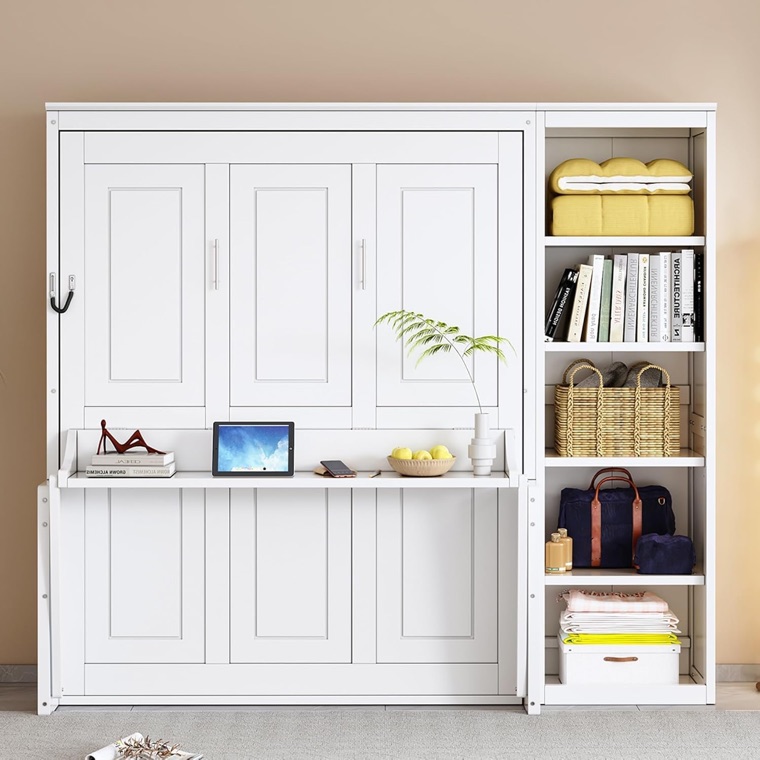
Vertical wall-bed-with-desk. A full-height cabinet mounted to a stud wall. The desk is either fixed at the base with the mattress folding up behind it, or built into a panel that stays level as the bed comes down (gyro/gravity mechanism). You lose about 15 to 20 inches of depth to the closed cabinet and about 80 to 90 inches of projection when the bed is down. Requires studs and, usually, two people to assemble.
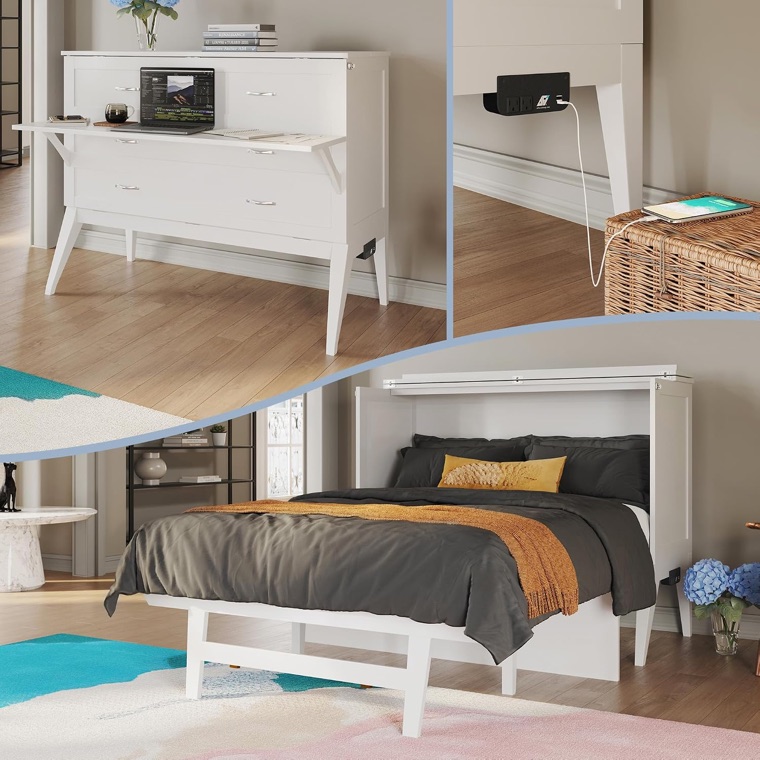
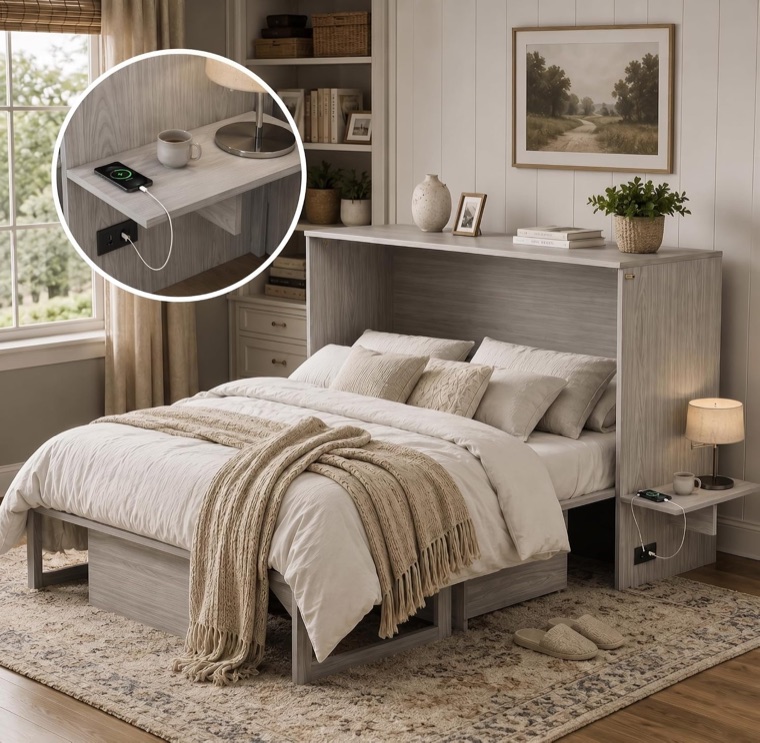
Cabinet bed with a fold-down desk. A chest-height cabinet that a tri-fold mattress lives inside; the desk is a hinged panel that folds down over the closed cabinet during the day. No wall anchoring, no lifted assembly, and it fits under a window or a low sloped ceiling. The tradeoff is that you have to close the cabinet before you can put the desk down.
The cabinet-bed vs wall-bed anatomy breakdown covers those two mechanisms in more detail.
What to measure before you buy
Wall beds with desks fail at the room-fit stage more than any other configuration, because there are two footprints to check, not one.
- Closed depth: how far the cabinet or unit sticks out from the wall with the bed folded up. Typically 15–24 inches for a vertical unit, 22–26 inches for a cabinet bed.
- Open projection: how far the mattress extends into the room when the bed is down. A queen is roughly 80 inches; a full is roughly 75 inches. Add clearance for whoever has to walk around the foot of the bed.
- Desk depth in “day mode”: whether your knees fit and whether a chair fits under it.
- Ceiling height: a full vertical queen unit often needs 88–92 inches. Measure floor-to-ceiling in the exact spot the unit will go, not the middle of the room.
- Stud spacing: for any wall bed, you need studs where the anchors go. Confirm on the listing which pattern the hardware needs.
Vertical wall bed vs cabinet-bed-with-desk: which fits your room
| Factor | Vertical wall bed + desk | Cabinet bed + fold-down desk |
|---|---|---|
| Wall anchoring | Required (studs) | None |
| Ceiling height needed | ~88–92“ for queen | Not a factor (chest-height) |
| Closed depth | 15–20“ | 22–26“ |
| Mattress type | Standard | Tri-fold |
| Desk usable with bed down | No | No (fold cabinet closed first) |
| Renter-friendly | Poor | Yes |
| Best for | Dedicated home office | Guest room or den that shifts modes |
Common mistakes buyers make
- Measuring the wall but not the projection. A queen wall bed will project about 80 inches into the room when open. If the desk chair is 30 inches from the wall, the bed will hit it.
- Assuming any mattress fits. Vertical units cap mattress thickness (often 10–12 inches). A thicker mattress will not fold up cleanly. Cabinet beds use a tri-fold mattress only.
- Skipping the anchor check. Drywall anchors are not a substitute for studs on a vertical wall bed. Confirm the anchoring pattern before you commit.
- Buying queen when full is the honest answer. If the bed is for occasional single-guest use, full costs less, weighs less, needs less wall, and projects less into the room.
Pre-purchase checklist
- Floor-to-ceiling height measured at the exact install point
- Wall width and stud pattern confirmed against the listing’s mounting spec
- Open projection plus at least 24“ of walk-around clearance
- Mattress thickness limit checked (or mattress included)
- Desk depth in day mode confirmed against your chair
- Delivery method confirmed (curbside freight for larger cabinets)
- Two people scheduled for assembly
If your room fails one of the first three items, a horizontal Murphy bed or a plain cabinet bed is a better answer than trying to force a vertical desk unit to fit.