Size guide
Twin Murphy Beds: Vertical and Horizontal Wall Beds for Small Rooms
A twin fits walls and ceilings a vertical queen cannot — but only if you pick the right orientation.
Short answer
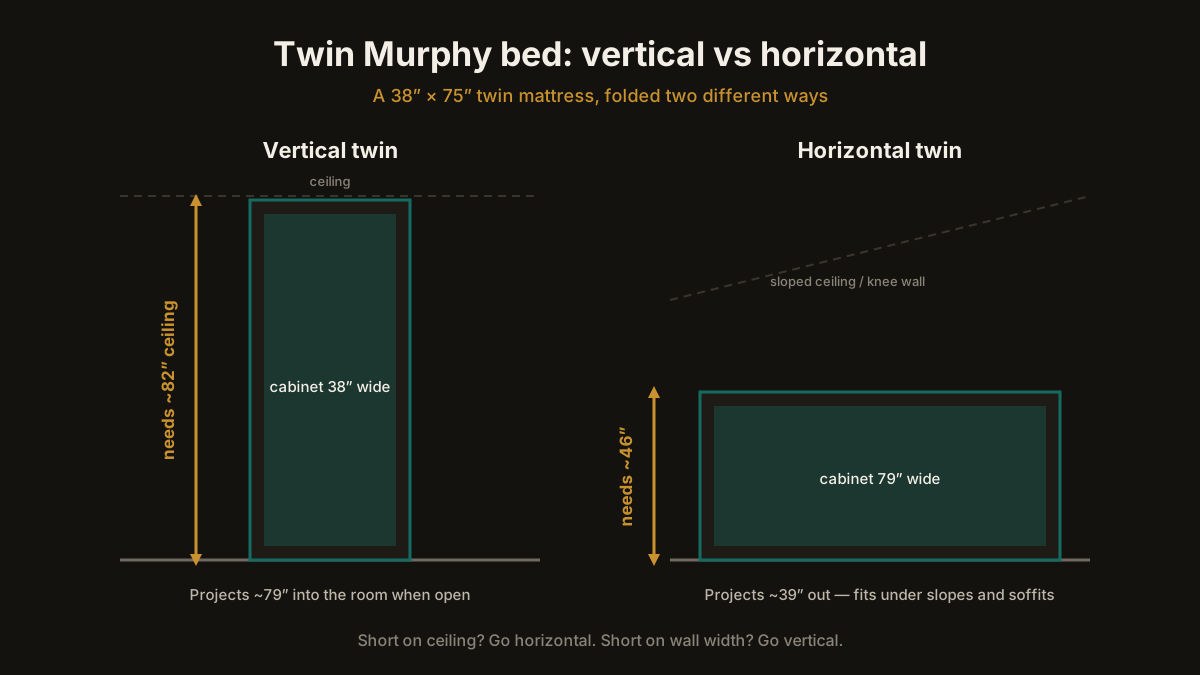
A twin Murphy bed folds a standard 38" x 75" twin mattress into a wall cabinet. Vertical twins need about 82 inches of ceiling and stick out about 39 inches when open; horizontal twins fit under low walls or slopes but eat more wall width. Dual-twin cabinets stack two beds in one unit for shared rooms.
Why buy a twin instead of a bigger Murphy bed
Twin Murphy beds are a specialty tool, not a compromise. There are three specific rooms where a twin is the right size, not just the small size.
Kids’ rooms and shared rooms. Two twins in a shared room means each kid has their own bed but the daytime floor is clear for play. A dual-twin cabinet does that in one wall unit instead of two.
Attic and dormer rooms. A twin’s shorter length (75 inches) and narrower width (38 inches) make it the only Murphy bed that fits comfortably under a knee wall or a sloped ceiling — especially in a horizontal orientation.
Home office guest beds where only one guest visits. A full-size Murphy bed is heavier, wider, and projects further into the room. If solo guests are the reality, a twin gives back nearly a foot of wall width and about 5 inches of projection.
If two adults will share the bed, a twin is the wrong pick — skip to queen cabinet beds or a full.
Vertical twin vs horizontal twin
The orientation isn’t a preference — it’s dictated by which wall dimension you don’t have.
Vertical twin: bed folds down toward you, foot-first. Needs at least 82 inches of ceiling height. Cabinet is about 41 inches wide. Open projection into the room is about 80 inches.
Horizontal twin: bed folds out sideways, long-edge first. Only needs about 47 inches of cabinet height, so it fits under sloped ceilings or above a low soffit. Cabinet is about 80 inches wide. Open projection is only about 40 inches — which matters in a narrow room.
The full horizontal Murphy bed guide covers the horizontal case in more depth. The vertical Murphy bed guide covers ceiling-height math.
Single twin vs dual twin
If you need two beds, the choice is between two single-twin cabinets or one dual-twin cabinet.
| Factor | Two single twins | One dual-twin cabinet |
|---|---|---|
| Wall width used | ~82“ (two 41“ cabinets) | ~80“ |
| Ceiling height needed | ~82“ per cabinet | ~90“ (stacked) |
| Anchoring | Two independent wall attachments | One unit, one anchor plan |
| Independent use | Yes | Yes (each bed folds separately) |
| Cost | Two mid-tier vertical units | One larger unit |
| Best for | Two rooms, or two walls in one room | One shared wall in a shared room |
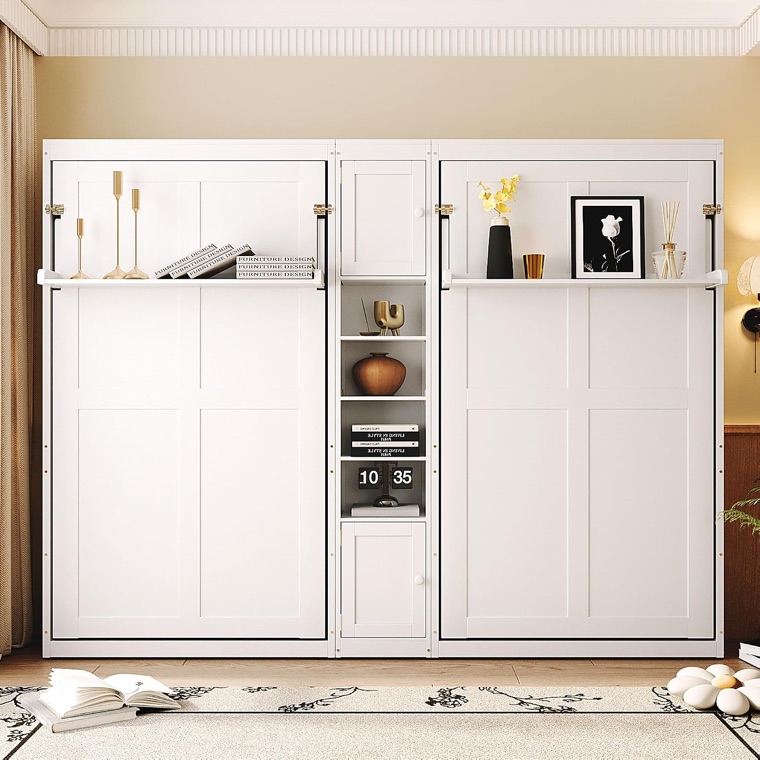
Dual-twin cabinets are the honest answer for a shared kids’ room where both beds live on the same wall. They save floor space at the cost of ceiling height.
Measure these before you buy
- Floor-to-ceiling height at the exact install location (attic ceilings are rarely flat).
- Wall width the cabinet will occupy, plus at least 3 inches of trim clearance each side.
- Open projection into the room, plus at least 24 inches of walk-around at the foot.
- Stud pattern — every twin wall bed needs anchoring into studs, no exceptions.
- Mattress thickness limit — most twins cap at 8 to 10 inches. A thick pillow-top will not fold cleanly.
- Delivery access — the box for a horizontal twin is 80+ inches long; confirm it fits through your stairwell.
Common mistakes
- Buying vertical when the ceiling is too low. Under 82 inches, a vertical twin will not stand up. Buy horizontal.
- Skipping the mattress cap. A twin mattress is easy to source, so the thickness constraint gets ignored. Confirm the number before you order a mattress.
- Assuming a dual-twin fits under an 8-foot ceiling. Some do; some need more than 90 inches. Measure.
- Forgetting the box. Twin Murphy beds ship in one long box. If your stairs turn tight, freight can get stuck.
Pre-purchase checklist
- Cabinet height vs floor-to-ceiling measured, with 2“ of clearance
- Cabinet width vs wall width, with 3“ trim clearance each side
- Open projection plus 24“ walk-around
- Stud pattern matches the mounting hardware
- Mattress thickness limit confirmed on the listing
- Delivery path (stairwell, doorways) measured against the box length
If any of the height numbers fail, the horizontal Murphy bed is your fallback. If the whole room is under 80 square feet, read the small room guide before spending a dime.