Decision guide
Murphy Bed vs Wall Bed vs Cabinet Bed: What's the Difference?
Same idea, two builds — one sits on the floor, one hangs on the wall.
Short answer
'Murphy bed' is the umbrella term for any bed that folds away. A 'wall bed' is a Murphy bed that mounts to a stud wall and folds up vertically. A 'cabinet bed' is a Murphy bed built into a freestanding chest that folds inside. Wall beds need anchoring and ceiling height; cabinet beds need floor space and a tri-fold mattress. Both are Murphy beds — different mechanisms.
Untangling the names
Three terms, one category, a lot of confusion. Here’s the honest breakdown.
Murphy bed — the umbrella term. Any bed that folds away when not in use. Named after William Murphy’s 1900 patent. Every folding-away bed on Amazon calls itself a Murphy bed at some point in the listing.
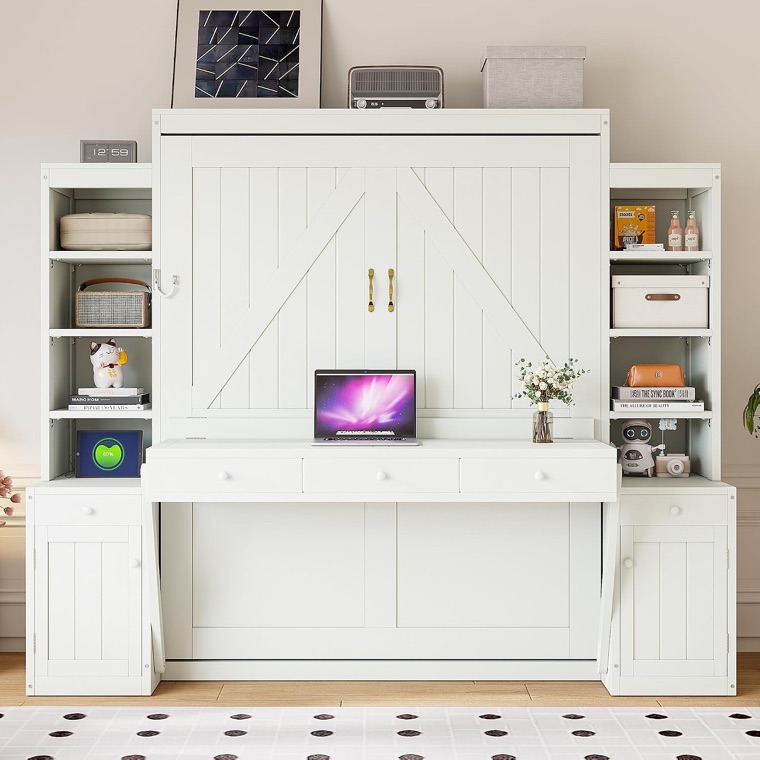
Wall bed — a Murphy bed mounted to a wall. Vertical cabinet, mattress folds up, hardware anchored into studs. Usually what people picture when they hear “Murphy bed” — but only one of two mechanisms.
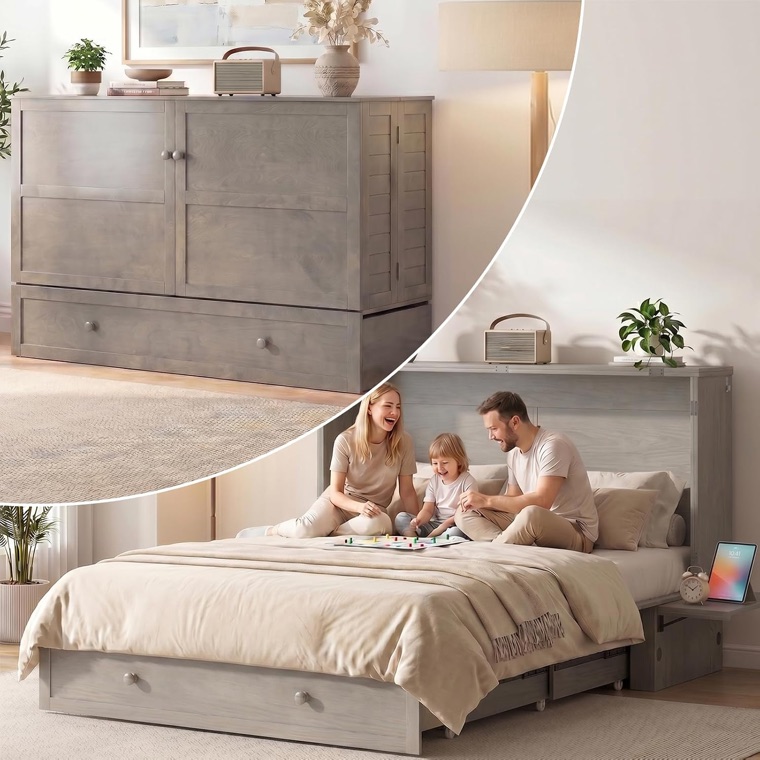
Cabinet bed — a Murphy bed built into freestanding chest-height furniture. Tri-fold mattress folded inside. No wall drilling. Sometimes called a “chest bed” or “stealth bed” by specific brands.
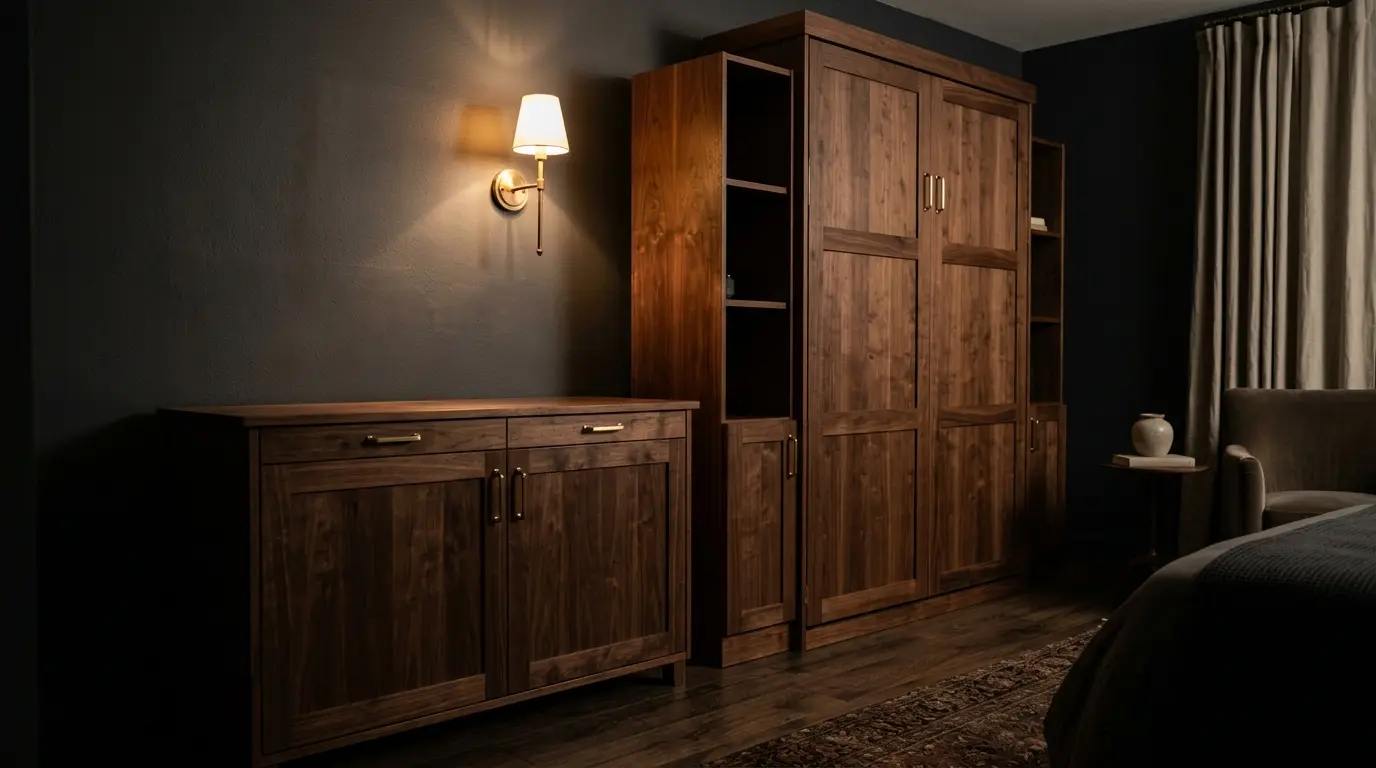
Wall bed and cabinet bed are both Murphy beds. They are not the same product.
What actually differs — mechanism, not name
The name argument matters less than the mechanism. Here’s what changes between the two:
| Factor | Wall bed | Cabinet bed |
|---|---|---|
| Mounting | Studs required | Freestanding, no drilling |
| Cabinet height | Full-height (82–92“) | Chest-height (25–43“) |
| Mattress | Standard | Tri-fold only |
| Overnight comfort | Better (standard mattress, solid platform) | Good (with a quality 6“+ tri-fold) |
| Installation | Two people, ~4 hours, hardware | Assemble in place, no wall work |
| Renter-friendly | Poor | Yes |
| Ceiling height needed | 82–92“ | Not a factor |
| Storage | Optional (front-panel shelves, side towers) | Standard (base drawers) |
| Price tier at same size | Similar or slightly higher | Similar or slightly lower |
Cabinet bed: how it actually works
A tri-fold mattress lives folded inside a chest-height cabinet. Swing the top and internal frame out, unfold the mattress, done. The whole thing works by gravity plus a few hinges.
- No wall hardware. No studs.
- Ceiling height doesn’t matter — the cabinet doesn’t stand tall.
- Storage lives in base drawers built into the cabinet.
- Delivery is usually freight because cabinets are heavy.
Where it fits: rentals, low-ceiling rooms, rooms without a drillable wall, guest rooms that need a decent bed without a project.
Where it doesn’t: nightly primary sleep, buyers who won’t tolerate a tri-fold mattress. See the cabinet bed guide for the full breakdown.
Wall bed: how it actually works
A vertical (or occasionally horizontal) cabinet mounts to a stud wall. Inside is a standard mattress on a platform held by gas struts and counterweights. Fold up to close, fold down to sleep.
- Studs required. Drywall anchors do not hold a Murphy bed.
- Ceiling has to clear the cabinet — 82 inches minimum for twin/full, 88+ for queen.
- Standard mattress under the thickness cap (usually 10–12 inches).
- Delivery can be parcel for value tiers, freight for premium.
Where it fits: home offices, studios, dedicated Murphy-bed installs where the room’s whole design uses the wall. See vertical Murphy beds.
Where it doesn’t: rentals, low-ceiling rooms, buyers who can’t drill or don’t want to.
Which one is right for you — decision tree
Can you drill into stud walls? No → Cabinet bed. Yes → Continue.
Is your ceiling at least 82 inches (88+ for queen)? No → Cabinet bed or horizontal wall bed. Yes → Continue.
Is this a nightly primary sleep surface? Yes → Wall bed with a standard mattress. No → Either works — pick on install effort vs storage vs budget.
Does the room need to do something else during the day (office, living room)? Yes → Wall bed with desk or sofa integration. No → Either works — pick on install effort.
Common confusion to avoid
- “Murphy bed” doesn’t mean “wall bed” specifically. Some listings use it for cabinet beds too. Read the mechanism, not the name.
- “Cabinet bed” is not a synonym for “wall bed with a cabinet.” Cabinet bed = freestanding chest. Wall bed = anchored full-height unit.
- Not every “wall bed” needs a whole wall. A twin wall bed uses about 41 inches. A cabinet bed uses about 65 inches (more than some wall beds).
- Tri-fold is not automatically cheap. Good tri-folds cost real money. Bad ones ruin the whole product regardless of the cabinet.
Pre-purchase checklist
- Decided which mechanism (wall vs cabinet) based on the decision tree above
- Room measurements match the chosen mechanism’s fit needs
- Installation effort acceptable (wall bed = a small project, cabinet bed = assembly only)
- Mattress plan matches the mechanism (standard for wall bed, tri-fold for cabinet)
- Delivery method understood (parcel or freight)
If the numbers push you toward a cabinet bed, jump to the Murphy cabinet bed or queen Murphy cabinet bed guide. If you’re on the wall-bed side, the vertical Murphy bed guide covers the anchoring math.